The honest answer most contractors won't give you — when to file, when NOT to file, how Florida law protects you, and what document order saves your payout.
Most water damage claim advice online is written by insurance companies or lawyers who benefit from you filing. Here is a neutral, numbers-based framework used by experienced Orlando public adjusters.
The core question isn't "does my policy cover this?" — it's "will filing this claim cost me more over 3 years than just paying for repairs?"
The $3,000 Rule: In most Orlando scenarios, if your out-of-pocket repair cost (after deductible) is under $3,000, you'll lose money filing the claim over a 3-year horizon when factoring in premium increases. The break-even point for most Orange County homeowners is $4,500–$6,000 in recoverable benefits.
Understanding the premium math before you pick up the phone.
Yes — and in Florida, the increase is often steeper than national averages. A single water damage claim in Orange County typically triggers a 15–30% premium increase at your next renewal. With Florida homeowners already paying $4,200/year on average (vs. $1,400 nationally), that's an additional $630–$1,260 per year.
Over three years, that's $1,890–$3,780 in additional premiums before you even account for your deductible. This is why the $3,000–$5,000 threshold matters — anything below it and you're likely to lose money filing.
Two claims within three years puts you in a high-risk classification that most Florida private carriers will not write. You may be forced into Citizens Property Insurance — Florida's insurer of last resort — which carries higher rates and more claim scrutiny. Many Orlando homeowners who filed one minor claim discover this only when their renewal notice arrives.
Before filing, ask your agent directly: "If I file this claim, will my policy be up for non-renewal at next anniversary?" The answer will tell you everything you need to know about your insurer's posture.
The 2022 law change that shortened Orlando homeowners' window.
Florida reduced the claim filing window from three years to one year as part of the 2022 property insurance reform (SB 2-D). Under Florida Statute §627.70132, you now have:
Missing the 1-year deadline = forfeiting your claim entirely. Courts have been strict. Even 1 day late has resulted in complete claim denial. If you're unsure about your date of loss (which often matters with gradual leaks), call a public adjuster immediately.
This is where Orlando homeowners get caught. For sudden events (burst pipe, AC overflow), the date of loss is the day the damage occurred. For gradual leaks — which are common with Florida's aging slab-on-grade foundations and pier-and-beam construction in College Park — the insurer will often argue the clock started months before you noticed.
Document the discovery date with a timestamped photo the moment you see any water damage. Call DryGuard for a moisture assessment before calling your insurer — the assessment creates a professional record of the discovery date.
Hurricane vs. standard deductibles — the gap surprises most homeowners.
Orlando homeowners typically carry two separate deductibles — and confusing them is one of the most expensive mistakes made after a weather event.
| Deductible Type | Typical Amount | Applies To |
|---|---|---|
| Standard/All-Peril | $1,000–$2,500 | Burst pipes, appliance leaks, AC overflow, plumbing failures |
| Hurricane/Named-Storm | 2–5% of insured value | Any damage occurring during a named storm — even indirect water intrusion |
| Flood (NFIP) | $1,000–$10,000 | Separate NFIP or private flood policy required; standard HO does NOT cover flood |
| Mold Sub-limit | $10,000 cap (§627.714) | Florida caps mold remediation coverage at $10,000 unless you purchased additional mold coverage |
On a $450,000 Orange County home, a 2% hurricane deductible is $9,000. Many homeowners filing post-hurricane claims discover the hurricane deductible eliminates any recovery — while also triggering a premium increase and a claim record in CLUE (Comprehensive Loss Underwriting Exchange).
Doing things in the wrong order can void your claim or reduce your payout.
The order in which you take action after water damage directly affects your claim outcome. Insurers are trained to look for documentation gaps, and many claims are reduced or denied because homeowners skipped a step or did things out of sequence.
Critical: Under §627.70131, your insurer must acknowledge your claim within 14 days and pay or deny within 60 days. If they miss the deadline, interest begins accruing from the date of your initial notice. Keep all correspondence dated and in writing.
The most common Florida water damage type — and the most frequently disputed claim.
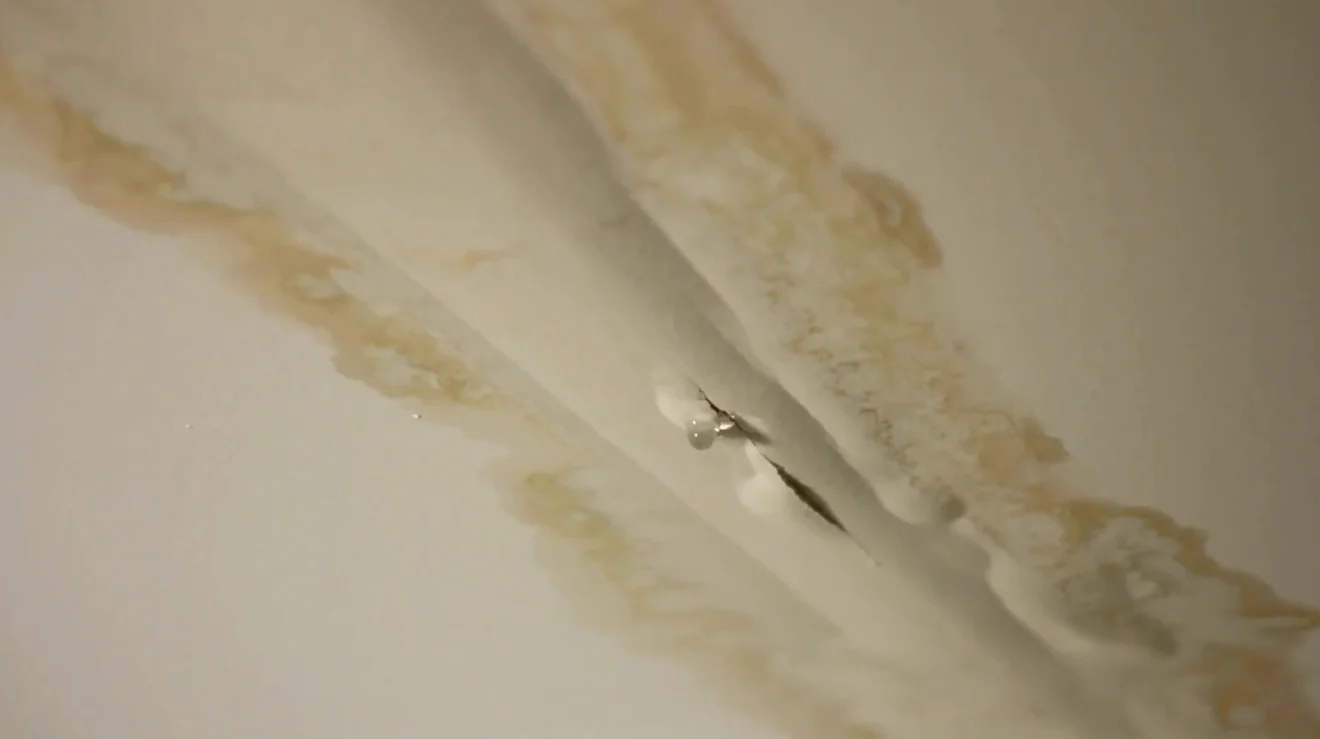
AC condensate overflow is the most common source of water damage claims in Central Florida — and also among the most disputed. Orlando's AC systems run 10+ months a year, and a single blocked condensate line can dump 5–10 gallons per day into walls and ceilings before a homeowner notices.
Most HO-3 policies cover "sudden and accidental" water damage — which theoretically includes AC overflow. However, insurers routinely argue that AC condensate damage was "gradual" rather than sudden, especially when it's discovered weeks after it began. This is the most litigated water damage coverage dispute in Florida.
Your claim outcome depends on these factors:
DryGuard's technicians are trained to document AC condensate damage in the language that supports coverage — including noting the overflow mechanism failure and the sudden onset markers that distinguish it from gradual seepage.
Situation: A Dr. Phillips homeowner discovered AC condensate water damage in a guest bedroom ceiling — about 12 sq ft of drywall and insulation, estimated at $3,200 to repair. She called DryGuard before calling her insurer.
Our Analysis: We noted she had filed a pipe leak claim 18 months earlier for $6,800. Filing a second claim would have: (1) moved her to high-risk classification, (2) potentially triggered non-renewal, and (3) added a second CLUE entry. Premium modeling showed a likely $2,800/year increase over the next 3 years = $8,400 in additional premiums vs. $1,700 net recovery ($3,200 − $1,500 deductible).
Outcome: She paid the $3,200 out of pocket. DryGuard completed remediation in 2 days. Her policy renewed without incident. She avoided $8,400 in premium increases and kept her claims history clean for future catastrophic events.
We'll assess your damage, estimate recovery, and give you an honest recommendation — file or pay out of pocket. No pressure, no sales pitch. Just the right decision for your situation.